

Overview
An air conditioner not cooling usually means your system is running, but it is not removing enough heat from your home or business to make the space comfortable. On a sticky Miami afternoon around 3 p.m., that can go from annoying to miserable fast. The good news is that some causes are simple and easy to check, while others point to a part that needs HVAC service.
What “air conditioner not cooling” usually means
When your AC is on but the place still feels warm or damp, the problem is not always that the whole system has failed. Often, one part of the cooling process is breaking down. Air may be moving, but not getting cold enough. Or the system may be cooling a little, just not enough to keep up.
Here’s the thing: air conditioning is basically heat-moving. Your system pulls heat from inside, carries it through refrigerant, and dumps that heat outdoors. If anything interrupts that chain, airflow, refrigerant, coils, electrical parts, or heat release outside, your comfort drops fast.
That is why “not cooling” can mean a lot of different things. Sometimes it is a thermostat setting. Sometimes it is a dirty filter. Sometimes it is a refrigerant leak or a failing capacitor. The symptom sounds simple, but the cause is not always simple.
Start with the quick things you can check yourself
Before assuming the worst, start with the easy stuff. A surprising number of no-cooling calls come down to something small, and checking a few basics can save time and stress.
Check the thermostat settings first
Start here because it takes about ten seconds. Your thermostat should usually be set to “cool,” and the fan should be set to “auto,” not “on.”
That small fan setting matters more than it seems. When the fan is set to “on,” air keeps circulating even when the system is not actively cooling. So you feel air coming out of the vents and assume the AC is working, but the air may be room temperature. It is a little like running a ceiling fan in a hot room. Air is moving, but the room is still hot.
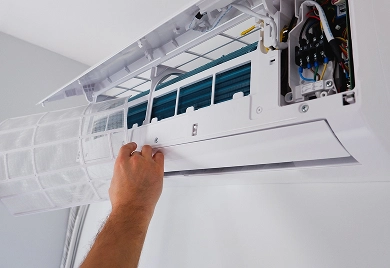
Look at the air filter
A clogged air filter is one of the most common reasons cooling gets weak. When the filter fills with dust, pet hair, and debris, air cannot move through the system the way it should. That chokes airflow and makes the AC work harder for worse results.
Pull the filter out and look at it in good light. If it looks gray, packed, or fuzzy, swap it. This is one of the few HVAC fixes that is cheap, quick, and genuinely effective.
Make sure vents and returns aren’t blocked
Your AC needs air to move freely in and out. Supply vents push conditioned air into rooms. Return grilles pull air back into the system to be cooled again. If either side gets blocked, performance drops.
Closed vents, sofas pushed against returns, stacked boxes, curtains, and even a rug can interfere. Your system cannot cool well if it cannot breathe. In a small office or retail space, this shows up all the time when furniture gets rearranged and airflow gets cut off without anyone noticing.
Check the breaker and power switches
Sometimes part of the system has power and part of it does not. You may hear the indoor unit running, but the outdoor unit is off. In that case, the AC can move air without actually cooling it.
Check the electrical panel for a tripped breaker. Also look at the shutoff switch near the outdoor unit to make sure it has not been turned off. If a breaker trips again after resetting, stop there. Repeated trips usually point to an electrical problem that needs service.
The most common reasons an AC runs but Doesn’t cool
Once the simple checks are out of the way, a few causes come up again and again. These are the problems that most often explain why your AC sounds active but your space still feels warm.
Dirty evaporator or condenser coils
Your system has two main coils. The indoor evaporator coil absorbs heat from your indoor air. The outdoor condenser coil releases that heat outside. If either one gets coated in grime, the heat transfer process slows down.
Dirty coils act like a winter jacket wrapped around the part that is supposed to move heat. The indoor coil struggles to absorb heat. The outdoor coil struggles to dump it. The result is weaker cooling, longer run times, and more strain on the system.
Low refrigerant or a refrigerant leak
Refrigerant is the fluid that carries heat out of the building. It circulates in a sealed loop. It does not get “used up” like gasoline, so if levels are low, that usually means there is a leak.
Common clues include weak cooling, hissing sounds, ice on the lines or coil, and an AC that runs much longer than usual without catching up. If refrigerant is involved, this is not a DIY fix. It needs proper leak detection, repair, and charging by a licensed HVAC technician.
Frozen AC components
Ice on your AC is a symptom, not the actual problem. Frozen coils or refrigerant lines usually happen because airflow is too restricted or refrigerant levels are too low.
What you notice at home is often confusing. You may get less airflow, warmer air, or visible frost on the indoor unit or refrigerant line. That seems backward, but once the coil ices over, cooling gets blocked. The system can end up blowing warm air because the whole process is jammed up.
A dirty or damaged outdoor unit
Your outdoor condenser needs space and clean surfaces to release heat. When it gets covered in leaves, dust, grass clippings, or grime, cooling performance drops.
In Miami and nearby areas, salt air, heavy humidity, long cooling seasons, and plain old outdoor buildup can make this problem show up faster. A unit near the coast can collect corrosive residue over time, and that extra wear shows up in reduced performance.
Blower, capacitor, or fan motor trouble
The blower pushes air through your ducts indoors. The outdoor fan helps the condenser release heat. The capacitor helps motors start and keep running.
When one of these parts starts failing, the symptoms can look strange. You may hear humming, clicking, or see the system start and stop without much cooling. You may also notice weak airflow from the vents, even though the thermostat says everything is running.
What it means when the symptoms look different
Not every cooling problem looks the same. The pattern matters, because it points to different parts of the system.
AC is running, but the house never reaches the set temperature
If your AC runs for long stretches but never reaches the temperature you set, that usually points to a performance problem rather than a total breakdown. Airflow restrictions, dirty coils, low refrigerant, duct leaks, or aging equipment are common causes.
Sometimes the system is simply losing the race. It is cooling some, but not enough to overcome the heat load in the space. In Miami, high outdoor temperatures and humidity make that gap show up quickly.
AC is blowing air, but it isn’t cold
Airflow and cooling are not the same thing. If air is coming out of the vents but it is not cold, the issue is often thermostat settings, frozen coils, refrigerant problems, compressor trouble, or an outdoor unit that is not releasing heat properly.
This is why “the fan is working” does not mean the AC is cooling. One half of the system can look alive while the actual cooling cycle is failing.
AC turns on and off, but cooling is inconsistent
When the system starts, stops, and repeats too quickly, that is called short cycling. It is hard on the equipment and bad for comfort.
Short cycling can come from thermostat issues, dirty components, electrical faults, or a system that is too large for the space. You get bursts of cooling, but not the steady run time needed to pull enough heat and humidity out of the air.
One room feels fine, but the rest of the place doesn’t
Uneven cooling usually points to airflow or building-related issues. Duct leaks, blocked vents, poor insulation, heavy sun exposure, or zoning problems can all create hot spots.
This matters in both homes and small businesses. A front office, back room, or second floor can feel completely different from the rest of the building, even when the AC itself is technically running.
When It’s safe to try a simple fix , and when to stop
There is a clean line between basic checks and actual repair work. Knowing that line saves time and avoids making the problem worse.
Safe things to try first
It is usually safe to replace a dirty filter, correct the thermostat setting, open closed vents, and clear light debris from around the outdoor unit. If the system is frozen, turn cooling off and let it thaw. Running the fan by itself can help move air during the thaw.
Those are low-risk first steps. They help with simple causes and can make the service call more productive if the issue turns out to be deeper.
Signs you should call for HVAC service
If your AC is still blowing warm air after the basics, it is time to stop guessing. Ice on the unit, water overflow, breaker trips, buzzing, burning smells, refrigerant concerns, or an outdoor unit that will not run all point to a problem that needs service.
The big one is refrigerant. If refrigerant is involved, this is not a DIY fix. It requires the right tools, the right handling, and the right diagnosis.
Why this problem shows up so often in miami
Cooling issues show up more often in South Florida for one simple reason: your AC works harder, longer, and under rougher conditions than systems in milder climates.
Heat, humidity, and long run times
Your AC is not just cooling the air. It is also pulling moisture out of it. That extra moisture load matters because humid air feels heavier, stickier, and harder to cool.
In Miami, your system can run for long stretches for much of the year. Small issues that might stay hidden in a cooler climate tend to show up fast here, because the equipment rarely gets much of a break.
Salt air, debris, and [maintenance](/maintenance-plans/) gaps
Coastal air can be rough on outdoor equipment. Salt, grime, and debris build up over time, especially on condenser coils and metal components. Add skipped tune-ups, and a minor efficiency problem can turn into a no-cooling problem pretty quickly.
That is the catch in this climate. Maintenance is not just about keeping things tidy. It directly affects how well your AC survives heavy use.
What an HVAC technician usually checks
A service visit feels a lot less mysterious once you know what gets inspected. The goal is not just to get cold air back for the moment. It is to find the actual reason cooling dropped.
Airflow, electrical parts, and thermostat operation
A technician will usually start by checking thermostat operation, airflow, and the electrical side of the system. That includes filter condition, blower performance, capacitors, contactors, and basic electrical readings.
In plain English, this tells you whether the system is getting the right signals and whether the motors and controls can do their jobs.
Refrigerant levels, leaks, and coil condition
Next comes the cooling cycle itself. Refrigerant pressure may be measured, leaks may be checked, and both indoor and outdoor coils may be inspected for dirt, freezing, or damage.
This part matters because low refrigerant, dirty coils, and freeze-ups often overlap. Fixing the symptom without finding the cause usually leads to the same problem coming back.
Drain line, ductwork, and overall system health
A technician may also check the condensate drain line, because clogs can cause water issues and trigger shutdowns on some systems. Duct leakage, wear on larger parts like the compressor, and overall system condition may also be reviewed.
That fuller inspection helps separate a one-off issue from a system that is starting to wear out.
How to help prevent cooling problems from coming back
You cannot prevent every AC problem, but you can lower the odds of another sweaty afternoon with a system that is running and not cooling.
Change filters on a steady schedule
Regular filter changes protect airflow and reduce strain on the whole system. If you have pets, extra dust, or heavy daily AC use, check the filter more often than the package suggests.
A clean filter is small, boring, and incredibly effective. Honestly, few maintenance steps do more for less effort.
Keep the outdoor unit clear
Give the condenser room to breathe. Keep plants trimmed back, remove leaves and debris, and watch for buildup around the unit.
When the outdoor section can release heat properly, your whole system works better. That simple.
Book routine AC maintenance before peak heat
Routine maintenance helps catch dirty coils, weak electrical parts, drainage problems, and refrigerant issues before they turn into a no-cooling call. In a place like Miami, where cooling season barely takes a break, timing matters.
The smartest move is to get ahead of the hottest stretch, not wait until your AC is running nonstop and your space still feels sticky.
Quick answers about an air conditioner not cooling
Why is your AC running but not cooling?
The most common reasons are dirty filters, thermostat settings, blocked airflow, dirty coils, low refrigerant, or failing electrical and motor parts. The system may still run, but one part of the cooling cycle is not doing its job.
Can a dirty filter really stop your AC from cooling?
Yes. A dirty filter can reduce airflow enough to weaken cooling, strain the blower, and even cause the indoor coil to freeze. One cheap filter can create a surprisingly big problem.
Should you turn the AC off if it’s frozen?
Yes. Turn the cooling off and let the system thaw. Ice usually means there is an underlying issue, often restricted airflow or low refrigerant, so thawing helps but does not solve the root cause.
Is it worth repairing, or is it time to replace the system?
Look at the age of the system, the repair cost, how often it breaks down, and whether it can still keep up with Miami heat. If the unit is older, struggling every summer, and stacking up repair bills, replacement starts to make more sense than another patch.
Once you understand what “air conditioner not cooling” actually means, the problem gets a lot less frustrating. Start with the easy checks, stop at the signs of a real repair issue, and do not ignore a system that keeps running without making the space comfortable. If you try one thing today, make it the filter. That one small check solves more cooling complaints than most people expect.
Disclaimer: This article is for general informational purposes only. It is not professional advice, a quote, or a service agreement. Conditions at your home or property may differ; contact a qualified professional for an on-site evaluation before making repair, safety, or spending decisions.